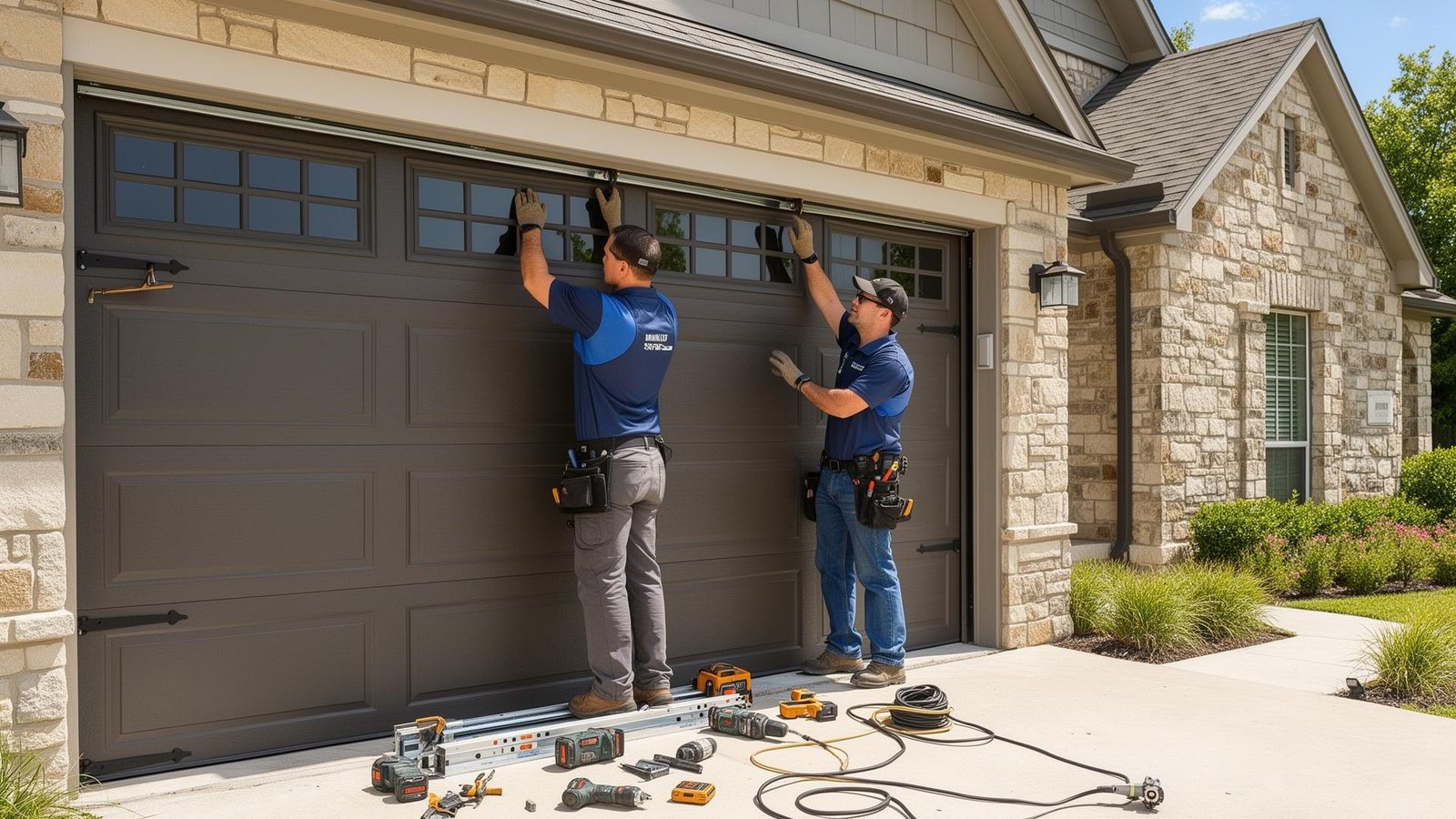
A commercial garage door going down in the middle of a workday is a different kind of problem than a broken door at home. At home, it’s frustrating. At a business, it can stop deliveries, lock out vehicles, create a security gap, and leave your staff standing around waiting for something to get fixed. In a warehouse, loading dock, or fleet facility, the door is infrastructure. It’s not optional.
This is what commercial garage door repair actually looks like in Austin – what breaks, what it costs, and what separates a company that knows commercial work from one that mostly does residential and occasionally takes a commercial call.
Why Commercial Doors Aren't Just Bigger Residential Doors
This distinction matters more than people realize when they’re calling around for quotes.
A residential garage door might open and close eight to ten times on a busy day. A commercial door on a loading dock, a car dealership service bay, or a storage facility can cycle fifty, sixty, eighty times in a single shift. The mechanical demands are completely different. Commercial torsion springs are rated for far more cycles. The operators run heavier duty motors. The tracks, cables, and rollers are built to handle sustained use rather than occasional use. The whole system is engineered around a different set of assumptions about how hard it’s going to work.
What this means practically is that not every technician who’s good at residential work is equipped to handle commercial equipment. The spring tension alone on a large commercial door is a serious safety consideration. If you’re getting quotes around Austin or out in Round Rock, Cedar Park, or Pflugerville, it’s worth asking point blank whether the company does commercial work regularly or just occasionally. That’s not a rude question – it’s a reasonable one that tells you a lot about what kind of answer you’re going to get.
What Actually Breaks on Commercial Doors
Torsion springs are the most common failure point, and they’re also the most disruptive when they go. The spring system does the counterbalancing work – it offsets the weight of the door so the motor isn’t carrying everything alone. When a spring breaks, you usually know immediately. The door won’t open, or it opens six inches and stops, or it feels like it weighs twice what it normally does. On a commercial door, torsion springs store a significant amount of mechanical energy and replacing them is not something to attempt without the right equipment and training. A spring under that kind of tension can cause serious injury if it’s handled incorrectly.
The operator is the next thing that tends to go, and the diagnosis can go a few different directions. Sometimes it’s something minor – a tripped breaker, a limit switch that’s drifted out of calibration, a loose connection on the control board. Other times the motor itself has burned out from years of hard use. A good technician figures out which one you’re dealing with before recommending a new unit, because those are very different repair bills.
Track and panel damage are common in commercial settings for an obvious reason – there’s a lot more traffic moving near the door. A forklift catching the edge of a track, a delivery truck that didn’t clear the opening cleanly, a vehicle that started moving before the door was fully up – these things happen. A bent track that doesn’t get addressed makes every other component in the system work harder. Rollers wear faster, cables develop uneven tension, and what started as a straightforward track repair becomes a bigger job the longer it runs.
Cables are another high-wear item on doors that cycle constantly. They fray over time, they can slip off the drum, and they snap. When a cable goes on one side, the door opens unevenly and puts stress on everything else. The reason cable problems tend to show up on inspections as a near-miss is that there’s usually visible fraying before an actual break – which is exactly why regular maintenance on commercial doors pays for itself.
Sensors and safety systems matter more in commercial settings than a lot of facility managers realize. Photo eyes, safety edges, loop detectors – these are the systems that keep the door from closing on a vehicle or a person. When they malfunction, the door might refuse to close, reverse for no apparent reason, or stop responding to controls. These are usually quick fixes when caught early. When they’re ignored, they become a liability issue.
What Repairs Actually Cost in Austin
Spring replacement on a commercial door runs somewhere between $200 and $500 in most cases, depending on the spring size and whether anything else in the system needs attention at the same time. Commercial springs cost more than residential springs, and they take longer to replace safely.
Operator work is all over the map. A diagnostic visit with a straightforward adjustment might be $100 to $150. A full commercial operator replacement – depending on what your door needs in terms of horsepower and features – is realistically $600 to $1,500, and on heavy-duty industrial applications it can go higher.
Panel replacement is priced per panel. For standard commercial steel doors, somewhere between $150 and $400 per panel is a typical range, though availability of matching panels for older doors sometimes complicates pricing.
Cable replacement is usually in the $150 to $250 range for most commercial setups.
Emergency calls, which are a fact of life for commercial clients who can’t just wait until Monday, carry a premium. Most companies in the Austin area charge an additional $50 to $150 for same-day or after-hours service. That’s worth knowing going in rather than being surprised by it on the invoice.
Repair or Replace - How to Actually Think About It
The math that most experienced technicians use is pretty simple. If the repair is going to cost more than half of what a replacement would cost, and the door is already getting up there in age, replacement is usually the better decision. You’re not just paying for the immediate fix – you’re extending the life of a system that’s already proven it breaks down.
The other variable that matters for commercial clients is downtime risk. A door that’s been repaired three times in two years is a door that’s going to need a fourth repair. Every time it goes down, you’re losing time and potentially revenue. A new door with a manufacturer’s warranty and components that aren’t already worn is a different kind of investment than another patch on a system that’s tired.
That said, if the door is relatively young and the problem is clearly isolated – one spring, one cable, one panel – repair is almost always the right call. The underlying system is fine. Fix what broke and get back to work.
What to Look for When Calling Around
Response time is the first thing that matters for commercial clients in a way it doesn’t for homeowners. Ask any company you’re calling how quickly they can get to a commercial job. If same-day service for commercial work isn’t something they can reliably commit to, that tells you something about how they’re set up.
Whether they carry commercial parts on their trucks is a follow-up worth asking. A technician who shows up to a commercial spring job and doesn’t have the right spring with them is adding hours to your downtime.
Licensing and insurance are baseline requirements for commercial work. General liability and workers’ comp both need to be in place before anyone touches a commercial door system. Ask for proof. Any reputable company in Austin, Georgetown, Bee Cave, or Bastrop will hand it over without hesitation.
Get a written estimate before work starts. That’s standard practice for legitimate commercial repair work. If someone wants to begin before giving you a number, don’t let them.
Spring replacements, cable work, and operator adjustments usually wrap up in one to three hours. Operator replacements or anything involving structural damage to panels or tracks can run longer, particularly if parts need to be sourced.
Grinding or scraping sounds on a commercial door almost always mean metal-on-metal contact. The door is damaging itself with every cycle. Waiting doesn't make it cheaper to fix - it makes it more expensive. Get it looked at.
High-cycle commercial doors should be inspected and lubricated at least twice a year. Springs, cables, and hardware wear faster under heavy use, and catching problems on an inspection is a lot cheaper than dealing with them as emergency repairs.
For standard commercial repairs, yes - same-day service is generally available in Austin and surrounding areas including Round Rock, Cedar Park, Pflugerville, Georgetown, Bee Cave, and Bastrop. After-hours and weekend calls are available but carry an additional service fee.
Commercial door problems don’t get better on their own. The door that’s struggling today is the door that fails completely next week. Most repairs are fast and straightforward when they’re caught early, and significantly more involved when they’ve been running damaged for a while. If something’s off, the earlier you get someone out there, the simpler and cheaper it stays.
Share this :
Facebook
Twitter
WhatsApp
Email

wasiimlatiif142@gmail.com
Get free tips and resources right in your inbox, along with 10,000+ others
Latest Post

April 20, 2026
April 20, 2026