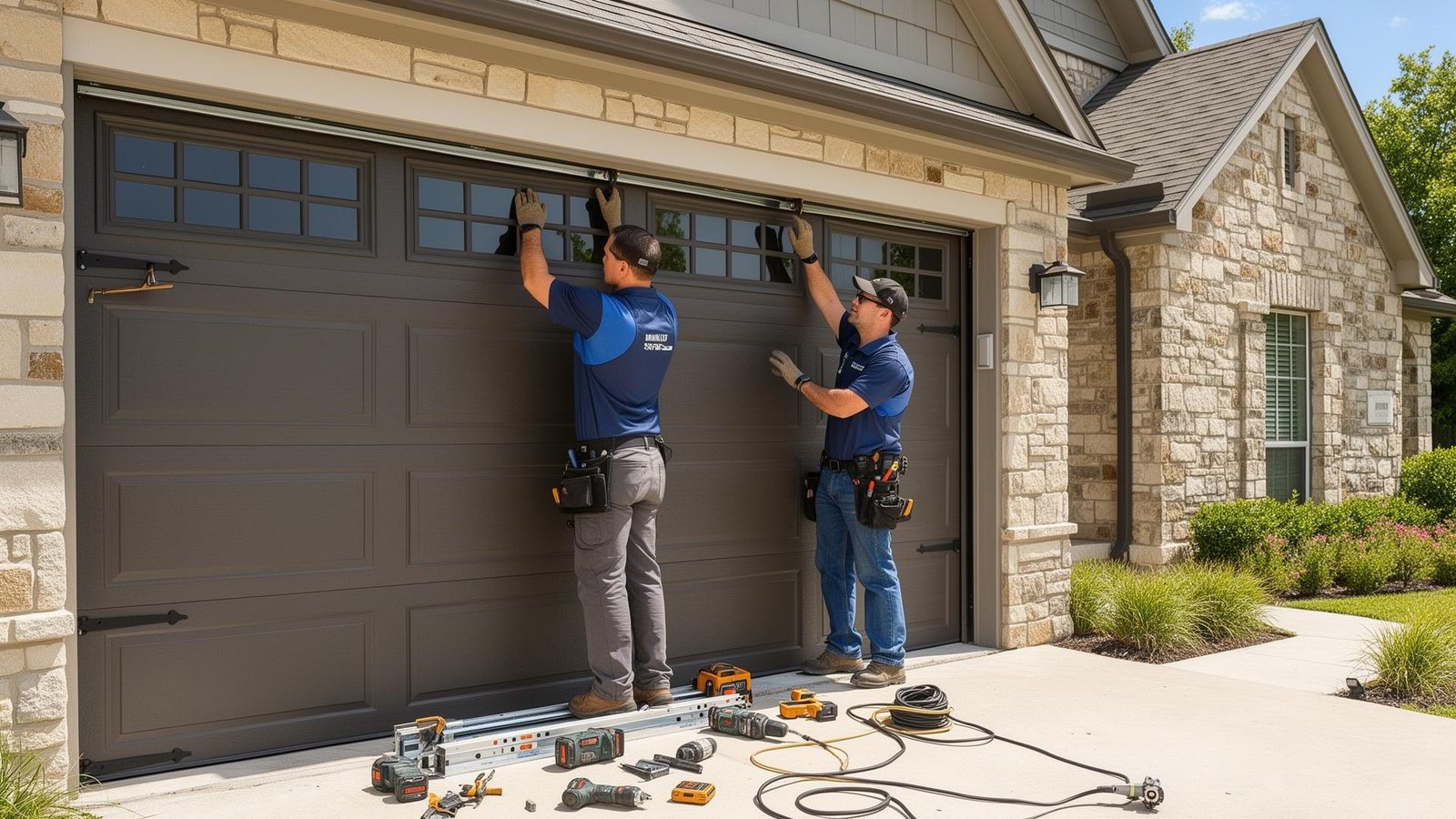
Door goes halfway down and bounces back up. Or it just refuses to close at all while the opener light blinks at you like it’s trying to communicate in morse code. Before you assume the opener is dying, check the sensors. That’s where this problem lives about 90 percent of the time.
The sensors sit low to the ground, right in the path of feet, bikes, brooms, and whatever blows in through the garage. Getting knocked around is basically their whole life. And in Austin where summer kicks up dust constantly and storms blow rain sideways into the garage, they take extra abuse. Good news is that most sensor fixes take less than twenty minutes and don’t require any tools.
What the Sensors Are Actually Doing
Two small units, one on each side of the door near the bottom of the track – usually sitting about four to six inches off the floor. One shoots an infrared beam across the opening. The other one catches it. Door path clear, beam intact, door closes. Something breaks the beam, door stops or reverses. That’s the whole system.
The trouble starts when the sensors think something is in the way when nothing actually is.
Look at the Lights First
Both sensors have indicator lights and they’ll tell you what’s wrong before you touch anything. The sending unit – usually the one with the amber or yellow light – should be steady. The receiving unit should show a solid green light when it’s picking up the beam properly.
Receiving light blinking, dim, or completely off? That’s where your problem is. The beam isn’t getting through, and the sensor is telling you so. Start there.
What Happens When Sensor Problems Get Ignored
A sensor issue that gets brushed off rarely stays a minor annoyance. The door reversing unexpectedly or refusing to close is the system flagging something that needs attention – and running the opener repeatedly against a sensor fault puts stress on the motor every single time.
The bigger concern is safety. Garage door sensors exist for one reason – to stop a 150 to 300 pound door from closing on something it shouldn’t. A sensor that’s malfunctioning, misaligned, or damaged isn’t providing that protection reliably. Most people don’t find that out until the door comes down on a car hood, a bike left near the entrance, or something worse.
Wiring problems left alone tend to get worse rather than better. A frayed wire or a loose connection that causes intermittent issues today becomes a complete failure down the road, usually at the least convenient moment. What started as a sensor fix can turn into an opener repair if the motor gets pushed hard enough for long enough against a fault it can’t resolve.
In Austin’s heat, sensor components and wiring deteriorate faster than most people expect. UV exposure, temperature swings, and dust work on the hardware constantly. A sensor system that’s showing signs of trouble on a door that’s eight or more years old often has more going on than what’s visible from the outside.
Getting a professional to diagnose it properly costs a fraction of what a full opener replacement runs – and a fraction of what it costs if the door comes down on something it shouldn’t have.
What Else Could It Be
Both sensor lights solid green, path clear, wiring looks fine, door still misbehaving – then you’re looking somewhere else.
An opener that’s getting old can develop logic board problems that look exactly like sensor issues. If the unit is ten or more years old and this came out of nowhere, that’s worth considering.
A door that’s binding or jumped off the track will trigger safety reversals that feel identical to a sensor problem. Get down and look at the rollers and track before assuming it’s electronics.
Remote not working but wall button works fine – that’s a remote problem, not sensors. Dead battery or a remote that needs reprogramming.
The seal itself is $20 to $50 depending on length and material. Add a threshold seal and you’re looking at another $30 to $60.
If you’d rather have someone come out and do it – especially if the retainer channel is damaged or the door isn’t sitting level – most garage door companies in Austin charge $75 to $150 for the full job, parts included. If the retainer needs replacing too, add $50 to $100.
Sensors are either misaligned, dirty, or something is crossing the beam. Check the receiving sensor light - if it's blinking, start with alignment. If it's solid, look for an obstruction or check the wiring.
You can, but it's a genuinely bad idea. Those sensors have been federally required on all residential openers since 1993 specifically because doors were closing on people and kids. Bypassing them permanently puts everyone at real risk.
Solid lights rule out alignment and beam problems but they don't rule out everything. Check whether the door is binding or off track, look at the logic board on the opener, and try the wall button override. If the door closes holding the button but not normally, the sensor signal is getting lost somewhere between the sensor and the motor.
Most go ten years without issues. Physical damage and water intrusion shorten that. If yours are original equipment on a door that's fifteen-plus years old and you keep having problems with them, replace them. At that age it's easier to just swap them than keep troubleshooting old hardware.
Direct sunlight on the receiving sensor. It overwhelms the infrared signal and the sensor loses the beam even though nothing is blocking it. Shade the sensor and the problem goes away
Still Not Fixed?
If you’ve been through all of this and the door is still not cooperating, something deeper is going on – wiring inside the motor unit, a failing logic board, or a track issue that keeps knocking the sensors out no matter how many times you realign them.
We’re out in Austin, Cedar Park, Round Rock, Pflugerville, and the surrounding area every day. Give us a call and we’ll come out, find what’s actually causing it, and fix it right. Get a free quote today.
Share this :
Facebook
Twitter
WhatsApp
Email

wasiimlatiif142@gmail.com
Get free tips and resources right in your inbox, along with 10,000+ others
Latest Post
April 20, 2026
April 20, 2026